Cézanne Salon
Generative benchmark · Flux.1-dev · 4 paintings · 3 periods · 20 scored runs
Ask the model for a realistic apple and it obliges. Ask for Cézanne's apple, built from unblended patches of color on a table that tilts toward the viewer, and it hands back a photograph.
The benchmark's central finding: the model replicates Cézanne's iconography but not his technique. It gives you surface or scene, never both.
The Murder
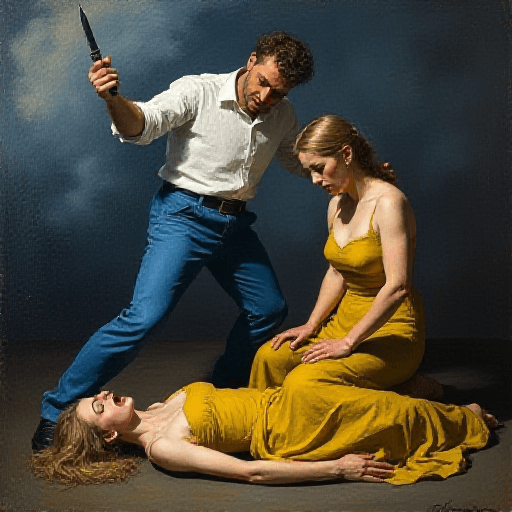
Early period, 1867
Flux can generate violent figurative scenes. It cannot generate Cézanne's violent figurative scenes. Across five runs with progressively refined prompts, the model defaulted to cinematic, photorealistic rendering regardless of explicit instruction. The model knows what a murder looks like. It does not know what Cézanne's decision to paint a murder crudely, flatly, and without academic finish looks like. Every iteration that increased subject specificity pulled the model further toward photorealism; every iteration that increased medium specificity improved texture but lost the composition.
The Card Players
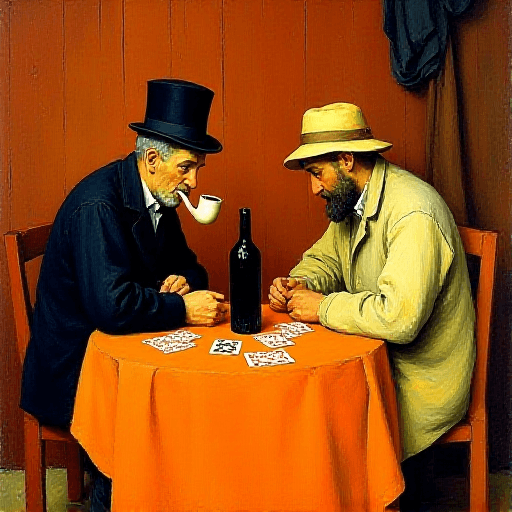
Middle period, 1892
By Run 5, every iconographic element of the painting was present and correctly placed: the two figures, the bottle centered between them, the ochre tablecloth, the bowler, the clay pipe. What the model could not do, across any run, was render the figures the way Cézanne rendered them. Three prompt strategies toward planar reduction failed; the bodies stayed fully three-dimensional. The runs also surfaced a methodological discovery: at its default CFG of 1.0, Flux underweights technique prompts to the point of ignoring them, and CFG 2.0 produced a category-level shift.
Fruit Bowl, Glass and Apples
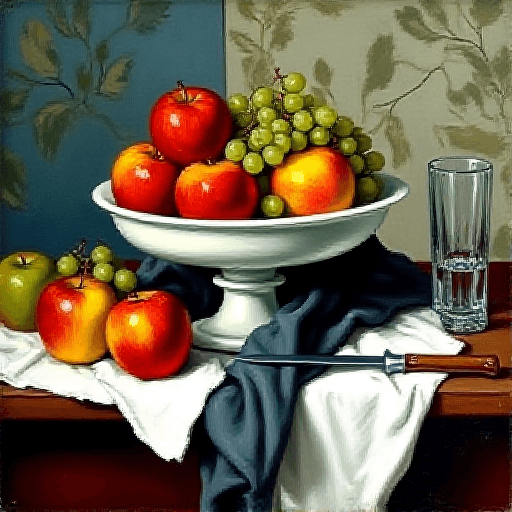
Middle period, 1880
The instructions that make the painting a Cézanne, the tilted tabletop, the flattened space, the broken color, either collapse the generation or are silently dropped. Pushed hard with stacked anti-realist language, the model abandoned the scene and resolved to a field of dark green and ochre color blocks: Cézanne's surface, the still life gone. Stripped back to a clean prompt, it produced the most beautiful render of the session with none of the requested impasto.
The Forest
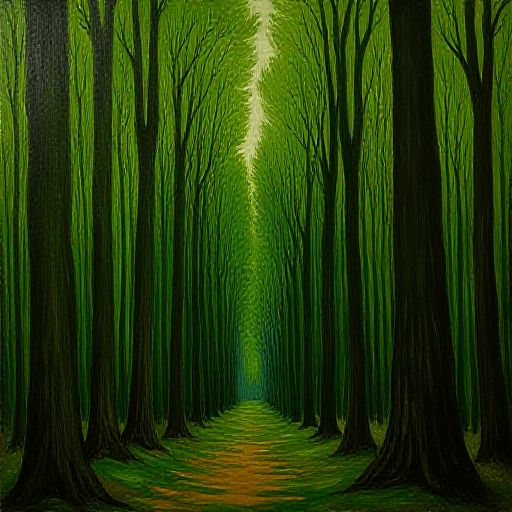
Late period, c. 1894
The maximum stress test: a subject that is already near-abstract. Across five runs the model re-imposed deep navigable space every time, through five different routes: unprompted one-point perspective, atmospheric recession, an open vista, the silent discarding of every anti-representational term, and finally a vanishing corridor built through a composition designed to forbid one. Planarity never exceeded 2 of 5.